


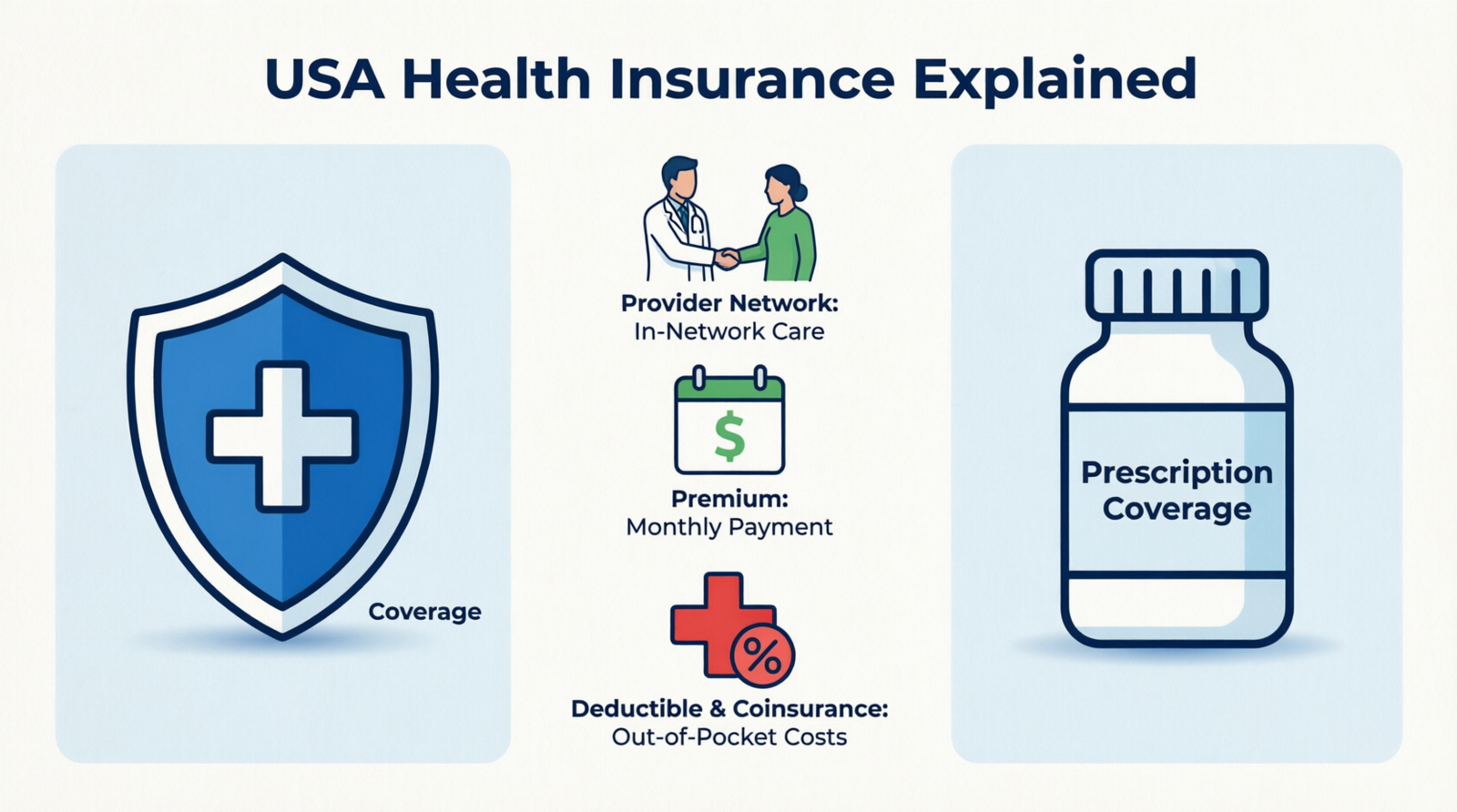
Health insurance is an important part of managing healthcare costs in the United States. Medical care can be expensive, and health insurance can help reduce the financial impact of covered healthcare services.
However, understanding health insurance can be challenging for people who are unfamiliar with terms such as premium, deductible, copayment, coinsurance, out-of-pocket maximum, network, and formulary.
Health insurance plans can also differ significantly in their benefits, provider networks, cost-sharing arrangements, and coverage rules.
This guide explains how health insurance works in the USA and what consumers should understand before selecting a plan.
What Is Health Insurance?
Health insurance is an agreement that helps cover certain healthcare expenses in exchange for premiums and compliance with the policy or plan’s terms.
Depending on the plan, insurance may help cover services such as:
- Doctor visits
- Hospitalization
- Emergency care
- Preventive services
- Prescription medications
- Laboratory services
- Diagnostic testing
- Mental health services
- Maternity and newborn care
- Rehabilitation services
Coverage varies by plan. A service being medically necessary does not necessarily mean every plan will pay the same amount for it.
Consumers should review their specific plan documents to understand what is covered and what costs they may have to pay.
Why Health Insurance Matters
Healthcare expenses can be unpredictable.
A routine doctor’s visit may be relatively affordable, while a serious illness, accident, surgery, or extended hospitalization can result in much larger bills.
Health insurance can help protect individuals and families from some of these costs.
For example, a person with insurance may still have to pay a deductible, copayment, or coinsurance, but the insurance plan may cover part of the remaining eligible expenses according to its terms.
Without insurance, a person may be responsible for the full cost of many healthcare services.
Main Ways Americans Get Health Insurance
People in the USA can obtain health coverage through several sources.
Employer-Sponsored Health Insurance
Many Americans receive health insurance through an employer.
In an employer-sponsored plan, the employer may pay part of the premium while the employee pays the remaining portion, depending on the plan.
Employees should review:
- Monthly payroll deductions
- Deductible
- Copayments
- Coinsurance
- Provider network
- Prescription coverage
- Out-of-pocket maximum
Employer plans can differ significantly, so employees should review the plan’s specific documents.
Individual and Family Health Insurance
People who do not obtain coverage through an employer may purchase individual or family health insurance.
Depending on eligibility, consumers may shop for coverage through the federal or state health insurance marketplace or directly through insurers and other authorized channels.
Marketplace plans may provide access to financial assistance for eligible individuals and families.
Medicare
Medicare is a federal health insurance program primarily serving people age 65 and older, along with certain younger people who meet specific eligibility requirements.
Medicare has different parts and coverage arrangements, so beneficiaries should understand which services each option covers and what costs may apply.
Medicaid
Medicaid is a joint federal and state program that provides health coverage to eligible individuals and families.
Eligibility and program rules vary by state.
Because Medicaid rules can change and differ across states, consumers should check current information from their state’s Medicaid program or other official resources.
Understanding Health Insurance Premiums
A premium is the amount paid for health insurance coverage.
Depending on the plan, premiums may be paid monthly or through payroll deductions.
For employer-sponsored insurance, the employer may contribute toward the premium.
For individual coverage, the policyholder generally pays the premium unless eligible for financial assistance that reduces the cost.
It is important to remember that the premium is not necessarily the only healthcare cost.
A plan with a low monthly premium may have a higher deductible or higher cost-sharing requirements.
What Is a Deductible?
A deductible is the amount a person generally pays for covered healthcare services before the insurance plan begins paying according to its cost-sharing rules.
For example, suppose a health plan has a $2,000 deductible.
If the plan requires the deductible to be met for a particular covered service, the insured person may have to pay eligible expenses toward that deductible before the insurer begins paying its share.
However, not every covered service necessarily requires the deductible to be met first.
Some plans may cover certain services, such as preventive care, before the deductible according to applicable rules.
Always check the specific plan.
What Is a Copayment?
A copayment, often called a copay, is a fixed amount that a covered person pays for a particular healthcare service.
For example, a plan might require a $30 copay for certain primary-care visits.
The actual copayment depends on the plan.
Some services may have different copays, and some may be subject to the deductible or coinsurance instead.
What Is Coinsurance?
Coinsurance is a percentage of the cost of a covered healthcare service that the insured person pays after meeting applicable deductible requirements.
For example, imagine a plan with 20% coinsurance for a covered service.
If the allowed amount for the service is $1,000 and the deductible has already been satisfied, the member’s coinsurance could be $200, while the plan would pay the remaining eligible amount according to the plan’s terms.
The actual calculation depends on the plan’s allowed amount and other cost-sharing rules.
What Is an Out-of-Pocket Maximum?
The out-of-pocket maximum is an important protection in many health insurance plans.
It represents the maximum amount a member generally has to pay during a plan year for covered services from in-network providers, subject to the plan’s rules.
Once the applicable out-of-pocket maximum is reached, the plan generally pays 100% of covered in-network benefits for the rest of the plan year.
However, not every expense counts toward the out-of-pocket maximum.
For example, premiums and certain out-of-network or non-covered expenses may not count.
Consumers should review their plan documents to understand exactly what is included.
Premium vs. Deductible vs. Out-of-Pocket Maximum
These three terms are easy to confuse.
Premium
The amount paid to maintain health insurance coverage.
Deductible
The amount you may need to pay for covered services before the insurer begins paying its share for services subject to the deductible.
Out-of-Pocket Maximum
The plan’s limit on certain covered in-network healthcare spending during the applicable plan year.
Understanding all three is essential when comparing health plans.
What Is a Health Insurance Network?
A provider network is a group of doctors, hospitals, pharmacies, and other healthcare providers that have agreements with an insurance company or health plan.
Using in-network providers may result in lower costs.
Some plans provide little or no coverage for non-emergency care received outside the network, while other plans may provide some out-of-network benefits at a higher cost.
Before making an appointment, it is important to verify that the provider is currently in-network for your specific plan.
Why Provider Networks Matter
A health plan may appear affordable based on its premium, but network restrictions can affect the total cost of care.
Before selecting a plan, consumers may want to check whether it includes:
- Their preferred primary-care doctor
- Specialists they regularly visit
- Nearby hospitals
- Preferred pharmacies
- Important medical facilities
Provider participation can change, so consumers should verify network status directly when necessary.
What Is a Primary Care Provider?
A primary care provider, or PCP, is often the healthcare professional who manages routine medical care.
Depending on the health plan, a PCP may help with:
- Routine checkups
- Preventive care
- Common illnesses
- Chronic-condition management
- Referrals to specialists
Some plans require members to select a PCP, while others do not.
What Is a Specialist?
A specialist is a healthcare professional who focuses on a particular area of medicine.
Examples include:
- Cardiologists
- Dermatologists
- Orthopedic specialists
- Neurologists
- Endocrinologists
- Oncologists
Some health plans require a referral before seeing certain specialists, while others allow members to make specialist appointments directly.
Health Insurance Preventive Care
Health insurance can cover certain preventive services without cost-sharing when specific federal requirements apply and the individual uses an appropriate provider.
Examples may include certain:
- Vaccinations
- Screening tests
- Preventive checkups
- Counseling services
Coverage rules can depend on age, risk factors, provider status, and other requirements.
Consumers should check their plan and applicable federal or state rules.
Prescription Drug Coverage
Prescription coverage is another important part of health insurance.
Plans may use a formulary, which is a list of prescription drugs covered by the plan.
Drugs can be placed into different tiers, with different cost-sharing requirements.
Before selecting a plan, people who regularly take prescription medication should check whether their medications are covered and whether their preferred pharmacy participates in the plan’s network.
What Is a Health Insurance Marketplace?
The Health Insurance Marketplace is a system through which eligible individuals and families can compare and enroll in health coverage.
Depending on income and other eligibility requirements, some consumers may qualify for premium tax credits or other financial assistance.
Marketplace rules, enrollment periods, and available plans can change.
Consumers should use current official information when applying or comparing coverage.
Open Enrollment and Special Enrollment
Health insurance enrollment is not necessarily available at any time under every program.
Marketplace plans generally have an annual open enrollment period, while certain life events may create eligibility for a special enrollment period.
Qualifying events can include circumstances such as:
- Losing qualifying health coverage
- Getting married
- Having a baby
- Adopting a child
- Moving in certain circumstances
The exact requirements and deadlines can vary.
Missing an applicable enrollment deadline may affect when coverage can begin.
What Is a High-Deductible Health Plan?
A high-deductible health plan (HDHP) generally has a higher deductible and a lower premium compared with some plans with lower deductibles.
The exact amounts that qualify as an HDHP can change over time under federal rules.
Some HDHPs are compatible with a Health Savings Account (HSA).
An HSA can provide tax advantages to eligible individuals, but eligibility depends on federal requirements.
Consumers should verify current rules before making financial decisions involving an HSA.
HMO vs. PPO
Two commonly discussed types of health plan structures are HMOs and PPOs.
HMO
Health Maintenance Organization plans generally use a network of providers and may require members to select a primary-care provider.
Some HMO plans require referrals for certain specialist care.
Out-of-network care is generally limited except in situations such as emergencies, depending on the plan.
PPO
Preferred Provider Organization plans generally provide more flexibility in choosing healthcare providers.
Members can often receive care from out-of-network providers, but the cost may be higher.
The exact rules differ among plans.
Neither structure should be evaluated solely by its name. The actual network, premium, deductible, cost-sharing, and benefits should be compared.
How to Compare Health Insurance Plans
When comparing health insurance, look beyond the monthly premium.
Consider the following:
Monthly Premium
How much will you pay to maintain coverage?
Deductible
How much might you have to pay before the plan begins paying its share for services subject to the deductible?
Copayments
What fixed amounts apply to common services?
Coinsurance
What percentage of eligible costs might you pay after meeting the applicable deductible?
Out-of-Pocket Maximum
What is the applicable annual limit for covered in-network expenses?
Provider Network
Are your preferred doctors and hospitals included?
Prescription Coverage
Are your regular medications covered at reasonable cost-sharing levels?
Benefits
Does the plan cover the services you are most likely to need?
Example of Comparing Two Plans
Imagine two hypothetical health plans.
Plan A
- Lower monthly premium
- Higher deductible
- Higher out-of-pocket exposure before reaching the plan’s limit
Plan B
- Higher monthly premium
- Lower deductible
- Different copayments and coinsurance
A healthy person who expects relatively little medical care may focus more on monthly costs and potential unexpected expenses.
Someone who expects frequent doctor visits, prescriptions, or planned procedures may place greater importance on deductibles, cost-sharing, and network coverage.
The right comparison depends on expected healthcare use and financial circumstances.
Common Health Insurance Mistakes
Choosing Only the Lowest Premium
A low premium can be attractive, but it may come with higher deductibles or other costs.
Ignoring the Provider Network
A preferred doctor may not participate in every plan.
Forgetting Prescription Costs
A plan’s drug coverage can make a significant difference for people who take regular medications.
Not Checking the Out-of-Pocket Maximum
Unexpected medical treatment can create substantial expenses. Understanding the plan’s out-of-pocket limit is important.
Failing to Review Coverage Annually
Healthcare needs and available plans can change. During applicable enrollment periods, consumers should review their coverage rather than automatically assuming the existing plan remains the most appropriate option.
How to Lower Health Insurance Costs
Consumers may have several ways to manage healthcare expenses.
Compare Available Plans
Compare premiums, deductibles, networks, prescription coverage, and out-of-pocket limits.
Use In-Network Providers
Using in-network healthcare providers can reduce costs when the plan provides different cost-sharing for in-network and out-of-network care.
Use Preventive Services
Where applicable, recommended preventive services may be available without cost-sharing when requirements are met.
Review Prescription Options
Ask whether generic alternatives or lower-cost covered medications are available when medically appropriate.
Consider an HSA-Eligible Plan
For eligible individuals, an HSA-compatible HDHP may provide tax advantages and a way to save for qualified medical expenses.
The suitability of this approach depends on the individual’s circumstances and current federal rules.
What Happens If You Lose Your Job?
Losing employer-sponsored health insurance can create a need for replacement coverage.
Depending on the circumstances, a person may have options that include:
- Marketplace coverage
- COBRA continuation coverage
- Coverage through a spouse’s plan
- Medicaid, if eligible
- Other qualifying coverage options
Eligibility and deadlines vary, so people experiencing a loss of coverage should review their available options promptly.
Frequently Asked Questions
How much does health insurance cost in the USA?
There is no single price for health insurance. Premiums and other costs vary based on factors such as plan type, location, age, household circumstances, coverage level, and eligibility for financial assistance.
What is the difference between a premium and a deductible?
A premium is the amount paid to maintain health insurance coverage. A deductible is the amount a member may have to pay for certain covered services before the plan begins paying its share.
Is a higher deductible better?
A higher deductible is not automatically better or worse. It may be paired with a lower premium, but it can result in greater costs when healthcare services are needed.
What is the out-of-pocket maximum?
It is generally the maximum amount a member must pay during a plan year for covered in-network services, subject to the plan’s rules. Premiums and certain other expenses may not count toward it.
What is the difference between an HMO and PPO?
HMOs generally use more structured provider networks and may require referrals for certain specialist services. PPOs generally provide greater flexibility, including some out-of-network coverage at higher costs.
Can I change my health insurance plan?
You may be able to change plans during an applicable open enrollment period or after certain qualifying life events. Rules depend on the type of coverage.
Final Thoughts
Health insurance in the United States can be complicated, but understanding the basic terms makes comparing plans easier.
Premiums are only one part of the total cost. Deductibles, copayments, coinsurance, out-of-pocket maximums, provider networks, prescription coverage, and covered benefits can all affect what you ultimately spend on healthcare.
When comparing plans, think about both your expected healthcare needs and your ability to handle unexpected medical expenses.
Most importantly, review the actual plan documents and current official enrollment information before making a coverage decision. Health insurance rules, costs, eligibility requirements, and available plans can change over time.
A plan that works well for one household may not be appropriate for another, so comparing the details against your own healthcare and financial circumstances is essential.