


Auto insurance is an important part of owning and driving a vehicle in the United States. It can help protect drivers from financial losses resulting from accidents, vehicle damage, theft, injuries, and other covered events.
Auto insurance requirements vary by state, and the coverage included in a policy can differ significantly between insurers. Understanding the basic types of coverage, policy limits, deductibles, and exclusions can help drivers make more informed decisions.
This guide explains how auto insurance works in the USA, what different types of coverage mean, what can affect premiums, and what drivers should consider when comparing policies.
What Is Auto Insurance?
Auto insurance is a contract between a vehicle owner or driver and an insurance company. The policyholder pays a premium in exchange for coverage subject to the policy’s terms, limits, deductibles, exclusions, and applicable state requirements.
Depending on the policy, auto insurance may help cover:
- Damage to another person’s vehicle
- Injuries to other people
- Damage to your own vehicle
- Theft
- Weather-related damage
- Collision-related losses
- Medical expenses
- Legal liability
- Uninsured or underinsured drivers
Not every policy includes all of these protections.
Why Is Auto Insurance Important?
Driving creates financial risks that can be difficult to handle without insurance.
A serious accident could involve:
- Vehicle repair costs
- Medical expenses
- Property damage
- Legal expenses
- Lost income
- Damage to another person’s property
Liability insurance is particularly important because a driver can potentially be financially responsible for damage or injuries caused to other people.
Auto insurance can help transfer some of these financial risks to an insurer, subject to the policy’s coverage and limits.
Is Auto Insurance Required in the USA?
Auto insurance requirements are generally established at the state level.
Most states require drivers to maintain some form of financial responsibility, commonly through liability insurance. However, the required coverage types and minimum limits vary by state.
Some states have different systems or requirements, so drivers should check the rules where their vehicle is registered and driven.
Meeting the legal minimum does not necessarily mean a driver has enough coverage for their personal financial situation.
Main Types of Auto Insurance Coverage
Auto insurance policies can contain several different types of coverage.
Liability Insurance
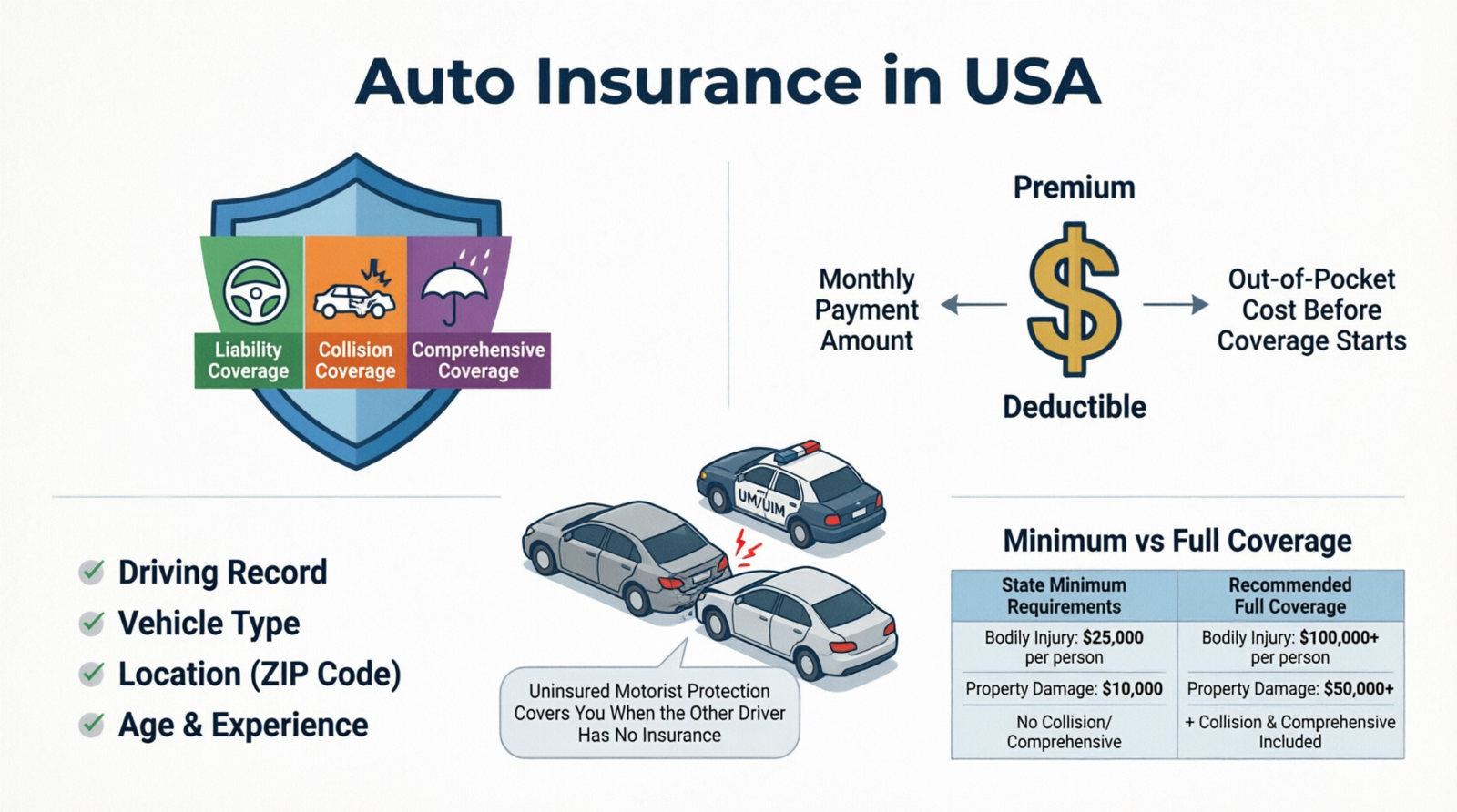
Liability coverage helps protect you when you are legally responsible for an accident that causes injury to another person or damage to their property, subject to policy terms and limits.
Liability coverage is commonly divided into:
- Bodily injury liability
- Property damage liability
Bodily Injury Liability
This coverage may help pay certain expenses when you are legally responsible for injuries to another person.
Potential expenses can include medical bills and other covered damages.
Property Damage Liability
This coverage may help pay for damage you cause to another person’s property, such as their vehicle.
Liability coverage generally does not pay to repair your own vehicle.
Collision Coverage
Collision coverage can help pay for damage to your insured vehicle resulting from a covered collision.
For example, collision coverage may apply when your vehicle:
- Hits another vehicle
- Hits a stationary object
- Rolls over
- Is damaged in another covered collision
A deductible generally applies.
If your vehicle is older and has a relatively low market value, you may want to compare the cost of collision coverage with the potential benefit.
Comprehensive Coverage
Comprehensive coverage generally protects against covered losses that are not caused by a collision.
Depending on the policy, examples can include:
- Theft
- Fire
- Hail
- Falling objects
- Vandalism
- Certain weather-related damage
- Contact with animals
Like collision coverage, comprehensive coverage generally has a deductible.
Uninsured Motorist Coverage
Uninsured motorist coverage can provide protection when you are involved in an accident caused by a driver who does not have the required insurance.
The exact coverage varies by state and policy.
This type of protection can be especially relevant because not every driver on the road necessarily has adequate insurance.
Underinsured Motorist Coverage
An underinsured motorist is a driver whose insurance is not sufficient to cover the damages associated with an accident.
Underinsured motorist coverage may help cover certain losses when the at-fault driver’s liability limits are insufficient, subject to the policy’s terms and applicable state rules.
Medical Payments Coverage
Medical payments coverage, sometimes called MedPay, can help pay certain medical expenses resulting from an auto accident.
Depending on the policy and state, it may cover the insured driver and passengers regardless of who caused the accident.
The exact benefits and coordination with other health coverage depend on the policy.
Personal Injury Protection
Personal Injury Protection, commonly known as PIP, is available or required in certain states.
PIP can provide broader benefits than basic medical payments coverage in applicable situations. Depending on state law and the policy, benefits may include medical expenses and certain lost-income or replacement-service expenses.
PIP rules differ significantly between states.
What Is an Auto Insurance Deductible?
A deductible is the amount you generally pay toward a covered loss before the insurance company pays the remaining covered amount.
For example, suppose your vehicle has $4,000 of covered damage and your collision deductible is $1,000.
If the entire $4,000 is covered, you would generally pay the first $1,000 and the insurer could pay the remaining $3,000.
The actual claim payment depends on the policy’s terms and coverage.
How Auto Insurance Premiums Are Determined
Auto insurance companies consider multiple factors when calculating premiums.
These can include:
- Driving history
- Age
- Location
- Vehicle type
- Annual mileage
- Coverage limits
- Deductibles
- Claims history
- Insurance history
- Credit-based insurance information where permitted
- Other insurer-specific rating factors
The importance of each factor varies by state and insurance company.
Driving Record
Your driving record can have a significant effect on auto insurance pricing.
Insurers may consider incidents such as:
- Speeding violations
- At-fault accidents
- Reckless driving
- DUI-related offenses
- Other serious traffic violations
A history with fewer serious incidents may qualify for different pricing than a history involving multiple violations or claims.
State laws also regulate how insurers can use driving information.
Vehicle Type and Insurance Cost
The vehicle you drive can influence your insurance premium.
Insurers may consider factors such as:
- Vehicle value
- Repair costs
- Safety features
- Theft rates
- Engine characteristics
- Claims history for the vehicle model
- Replacement costs
A vehicle that is expensive to repair or frequently targeted by thieves may have different insurance costs from a vehicle with lower repair or theft risks.
Location and Auto Insurance
Where you live and primarily drive can affect insurance pricing.
Insurance companies may consider factors such as:
- Traffic density
- Accident frequency
- Theft rates
- Weather risks
- Claims patterns
- Local repair costs
Drivers in urban areas may have different premiums from drivers in rural areas because driving conditions and insurance risks can vary.
Mileage and Driving Habits
The amount you drive can also affect insurance pricing.
Someone who drives a few thousand miles per year may have a different risk profile from someone who drives long distances every day.
Some insurers offer programs that use driving behavior or mileage information to help determine premiums, subject to applicable rules and consumer participation.
Credit-Based Insurance Information
In some states, insurers may use credit-based insurance information as one factor in determining auto insurance pricing or eligibility.
However, state regulations differ, and some states restrict or prohibit certain uses of credit information for auto insurance.
Consumers should check the rules applicable in their state.
How to Choose Auto Insurance Coverage
Choosing coverage should involve more than finding the cheapest premium.
Start by considering your financial situation and the potential risks you want to protect against.
Consider Your Liability Risk
If you cause a serious accident, the resulting damages could exceed the minimum liability limits required by your state.
Drivers with significant assets or income may want to discuss higher liability limits with a qualified insurance professional.
Consider the Value of Your Vehicle
Collision and comprehensive coverage may make more financial sense for a newer or higher-value vehicle than for a vehicle with a low market value.
Consider Your Deductible
A higher deductible may reduce the premium, but it also means you would have to pay more out of pocket after a covered claim.
Choose a deductible that you could reasonably afford if an accident occurred.
Minimum Coverage vs. More Extensive Coverage
State minimum insurance requirements are designed to establish a basic level of financial responsibility.
However, minimum coverage may not fully protect your financial interests.
For example, suppose your state requires a particular amount of liability insurance, but an accident causes damages that exceed your policy limits.
You could potentially remain personally responsible for amounts not covered by your insurance, depending on the circumstances and applicable law.
For this reason, some drivers choose limits above the legal minimum.
How to Compare Auto Insurance Quotes
When comparing auto insurance quotes, make sure you are comparing similar coverage.
Check:
- Liability limits
- Collision coverage
- Comprehensive coverage
- Deductibles
- Uninsured motorist coverage
- Underinsured motorist coverage
- Medical payments or PIP
- Rental reimbursement
- Roadside assistance
- Other optional coverage
A quote with a lower premium may simply provide less coverage or higher deductibles.
Discounts That May Be Available
Insurance companies may offer discounts based on different factors.
Potential discounts can include:
- Multi-vehicle discounts
- Bundling home and auto insurance
- Safe-driver discounts
- Good-student discounts
- Defensive-driving discounts
- Vehicle safety features
- Anti-theft devices
- Low-mileage programs
Availability varies by insurer and state.
Drivers should ask the insurer which discounts they may qualify for rather than assuming every discount is available.
Bundling Auto and Home Insurance
Some insurers allow customers to purchase multiple policies from the same company.
For example, a household might purchase both homeowners and auto insurance from one insurer.
The insurer may offer a multi-policy discount.
However, consumers should still compare the total cost and coverage of the bundled policies with alternatives. A discount on one policy does not automatically make the overall package less expensive.
What Happens After an Accident?
After an accident, the appropriate steps depend on the circumstances and applicable law.
Generally, drivers should prioritize safety, seek emergency assistance when necessary, exchange required information, document the scene when safe, and notify their insurer according to the policy’s requirements.
Useful information may include:
- Names and contact details
- Insurance information
- Vehicle information
- Photos of damage
- Photos of the accident scene
- Witness information
- Police report information, when applicable
Avoid admitting legal fault at the scene. Instead, provide factual information to the appropriate authorities and insurance company.
What Is an Insurance Claim?
An insurance claim is a request for payment or coverage under an insurance policy after a covered event.
The insurer generally investigates the claim and determines whether the loss is covered and how much is payable under the policy.
The process may involve:
- Reporting the accident
- Providing relevant information
- Vehicle inspection
- Damage assessment
- Coverage review
- Settlement or repair arrangements
The exact process differs among insurers and types of claims.
What Is a Total Loss?
A vehicle may be considered a total loss when repairing it is not economically practical under the insurer’s applicable standards or when state law defines it as such.
If a covered vehicle is declared a total loss, the insurer may pay the vehicle’s applicable actual cash value, minus any deductible, subject to the policy.
Actual cash value is generally based on the vehicle’s value immediately before the covered loss, not necessarily the amount the owner originally paid.
State rules can affect total-loss claims.
Gap Insurance
Gap insurance can be relevant to drivers who owe more on an auto loan or lease than the vehicle is worth.
For example, if a vehicle is worth $20,000 but the outstanding loan balance is $25,000, a total-loss claim based on the vehicle’s covered value may not pay the entire loan balance.
Depending on the specific product and contract, gap coverage may help address some of that difference.
Gap insurance is subject to its own terms, exclusions, and limitations.
Common Auto Insurance Mistakes
Choosing Only the Cheapest Policy
A low premium may come with lower liability limits, fewer coverage options, or higher deductibles.
Selecting State Minimum Limits Without Considering Financial Risk
Legal minimums may not be enough to protect your finances after a serious accident.
Choosing a Deductible You Cannot Afford
A lower premium is not useful if you cannot afford the deductible when a covered loss occurs.
Forgetting to Update Your Policy
Moving, changing vehicles, changing drivers in the household, or significantly changing how a vehicle is used can affect insurance needs.
Not Comparing Quotes
Different insurers may offer different prices for similar coverage.
How to Potentially Reduce Auto Insurance Costs
Drivers can consider several strategies to manage insurance expenses.
Compare Multiple Insurers
Prices can vary considerably among insurers for similar coverage.
Ask About Discounts
Ask the insurer about available discounts and eligibility requirements.
Review Your Deductibles
If financially appropriate, a higher deductible may reduce the premium.
Maintain a Good Driving Record
Avoiding serious violations and accidents can help maintain a favorable insurance history.
Review Coverage Regularly
Your insurance needs can change as your vehicle ages, your finances change, or your driving habits change.
Frequently Asked Questions
Is auto insurance mandatory in every state?
Most states require some form of financial responsibility, but specific requirements differ by state.
What is the difference between liability and full coverage?
“Full coverage” is not a standardized insurance policy term. It is commonly used to describe a policy that includes liability plus physical-damage coverage such as collision and comprehensive, but the exact coverage varies.
Is comprehensive insurance the same as collision insurance?
No. Collision generally covers certain collision-related damage to your vehicle, while comprehensive generally covers certain non-collision losses such as theft, fire, hail, vandalism, or animal-related damage.
Does a higher deductible lower my premium?
A higher deductible can reduce the premium in many cases, but the exact effect depends on the insurer and policy.
Can I change my auto insurance company?
Yes, consumers can generally switch insurers, but they should make sure new coverage is active before canceling an existing policy to avoid an uninsured gap.
Does my credit affect auto insurance?
In some states, insurers may use credit-based insurance information as a rating factor, while other states restrict or prohibit certain uses. Rules vary by state.
Final Thoughts
Auto insurance provides financial protection against many of the risks associated with driving, but policies differ significantly in coverage, limits, deductibles, exclusions, and pricing.
When comparing auto insurance in the USA, look beyond the monthly premium. Consider liability limits, collision and comprehensive coverage, uninsured and underinsured motorist protection, deductibles, provider services, and the value of your vehicle.
State minimum requirements can provide a starting point, but they may not fully address an individual’s financial risks.
Because insurance regulations and pricing practices vary by state, consumers should review the requirements that apply where they live and compare policies based on their own circumstances.
Before purchasing or changing coverage, carefully review the policy documents and ask the insurer to explain any terms or exclusions you do not understand.